Subtotal: 0
Ara Sargsyan
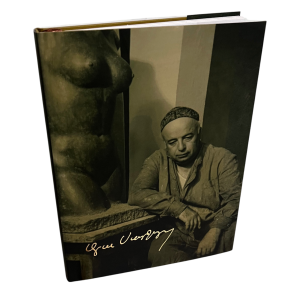
Ara Sargsyan is one of the pillars of our modern fine-arts. Ara Sargsyan is indivisible from the history of the Armenian people and its culture by his enormously pithy activities.
MARTIROS SARYAN
The bust displayed by Ara Sarksyan has attained a definite perfection that can only be achieved by hard work of many decades. Here, one feels the presence of a solid hand capable of building confidently, a keen eye that picks up quickly what is most characteristic to the object and gives bodily form to it. Sarksyan is still too young, and he may find himself in the front line, if he really could dc what he promises to do.
RICHARD EISENMENGER “Die Zukunft”, 13.05.1923, Vienna
Life and Artistic Legacy
Ara Sargsyan was born in 1902 in the Armenian village of Makri, near Constantinople. He received his primary education at the local Tatyan School and later attended the Yesayan Secondary School in Constantinople. From an early age, Sargsyan showed a deep passion for sculpture—by the age of eleven he was already modeling animal figures and sketching. His remarkable talent led him to enroll in the Constantinople Art School, where he began formal artistic training.
After several years of study, Sargsyan moved to Europe to continue his education. In 1921 he studied in Rome, and soon after in Vienna, where he entered the School of Masters under the guidance of renowned teachers Edmond Helmer and Josef Müllner.
Sargsyan’s artistic development took place during a dynamic period of competing movements in European art. Despite the shifting styles and ideologies surrounding him, he remained deeply rooted in his Armenian identity and cultural values. During these early years he created a series of expressive works, including Despair, Starvation, Mute Grief, Faun, Artist Saim, Mislay, and Lipshitz. The emotional impact of the Armenian Genocide profoundly influenced Despair and Starvation, both marked by intense human suffering and empathy.
His Viennese years represent an important stage in his evolution as an artist. Alongside the refinement of his technical skill, his works from this period display a strong sense of monumentality and clarity of form, as seen in Mute Grief and Faun. The romantic generalization and sculptural rhythm of these works align with the aesthetic principles of early 20th-century European art.
Upon completing his studies in 1925, Sargsyan—like many members of the Armenian intelligentsia scattered across the globe—returned permanently to Soviet Armenia. The country’s cultural revival filled him with renewed creative energy:
“I was moved by the passion for creation,” he wrote at the time.
His first works in Armenia, such as Woman with Jug and Harvest, symbolized the theme of new life and reconstruction.
By the late 1920s and throughout the 1930s, Sargsyan turned again to thematic compositions like Meeting and Building, exploring the harmony between rhythm and idea. His attention increasingly focused on the image of the “new man”—the Soviet citizen. During this time, he created portraits of Alexander Myasnikyan and other prominent Armenian intellectuals, including Hrachia Acharian, Manuk Abeghian, and Vahan Totovents, capturing both their individuality and moral strength.
In the same decade, Sargsyan produced a series of smaller sculptural forms—The Nude, After Bathing, The Swimming Woman—where he celebrated the timeless beauty of the human body. These compositions, noted for their vitality and elegance, reflect the influence of progressive European artistic trends.
The Second World War became a defining theme in Sargsyan’s later work. He created portraits of Armenian heroes and military figures such as Aram Mirzoyan, Nelson Stepanyan, O. Zardaryan, A. Givelegov, and Vahram Papazyan. A monumental version of his bust of Nelson Stepanyan was installed in Yerevan’s Kirov Park. War themes also appear in his dynamic compositions Taking of a Height, Tanya, and Partisan, which convey the collective heroism of Soviet soldiers through simplified, powerful forms.
Among his most significant historical works is the sculptural group depicting Mesrop Mashtots, the creator of the Armenian alphabet, together with his disciple Sahak Partev. The first version was made in 1943, followed by a wooden model and finally a large-scale plaster cast in 1962. Drawing inspiration from medieval Armenian sculpture, Sargsyan achieved a monumental grandeur in this composition.
The post-war years were among the most productive of his career. Inspired by the Soviet victory and Armenia’s cultural renewal, Sargsyan created works such as Vintage, celebrating the joy of free labor. The piece combines elements of round sculpture and high relief, blending realism with romantic expressiveness. During this time, he also sculpted portraits of eminent Armenian figures including Alexander Avetisyan, Vagharshak Ajemian, Suren Spandaryan, Stepan Shaumyan, architect Alexander Tamanyan, and poet Hovhannes Tumanyan.
Sargsyan’s interests extended to stage design as well. He designed sets for theatrical productions such as Hamlet, Uncle Baghdasar, and Respectful Beggars, with his decorative concept for Paronian’s plays on the Armenian stage considered among the finest of its era, vividly evoking the atmosphere of old Constantinople.
Throughout his life, Sargsyan repeatedly returned to his favorite subjects. He first sculpted a bust of the revolutionary Stepan Spandaryan in 1927 and revisited it twenty years later, imbuing the portrait with even greater emotional depth.
His monumental works of the 1950s and 1960s include Mother-Heroine, Ganfida, Hiroshima, and Tatev. In 1957, the Presidium of the Academy of Sciences of Armenia commissioned him to create high-relief panels for the new Academy building. These compositions depicted prominent figures from Armenian and world science—Confucius, Grigor Magistros, Anania Shirakatsi, Mkhitar Heratsi, and Isaac Newton—merging classical decorative balance with expressive modeling.
Equally impressive is his bust of King Artavazd, founder of the Armenian theater, where Sargsyan combined realistic portraiture with the noble features of an ancient commander and thinker (55–33 BC).
Ara Sargsyan’s work is distinguished by psychological depth, clarity of form, and an enduring sense of national identity. His aesthetic principles and artistic achievements played a pivotal role in shaping the early development of Armenian Soviet sculpture and inspired generations of artists to follow.